Stiff, Painful Neck? Cervicalgia Explained: Symptoms, Causes & Treatment
Do you wake up with a stiff neck? Does the pain creep into your shoulder, or get worse after a long day at a desk or bent over your phone? Maybe it hurts to turn your head when you reverse the car or check your blind spot. This is cervicalgia, the medical word for neck pain (cervicalgie in French). It is one of the most common reasons people see a doctor. The good news is that in most people it is not dangerous and it settles with simple measures. This guide explains what is going on, what you can do about it, and which warning signs mean you should not wait.
What Is Cervicalgia?
Cervicalgia simply means pain in the neck. It is a symptom, not a single disease, much like rheumatism. Your neck, called the cervical spine, is made of seven small bones (vertebrae) stacked on top of each other, cushioned by discs and linked by small joints, ligaments and many layers of muscle. It has to carry the weight of your head, around 4 to 5 kg, while letting you nod, turn and tilt thousands of times a day. With so much work to do, it is easily strained.
What Does It Feel Like?
- Aching, tightness or stiffness at the back or side of the neck.
- Pain when turning or tilting the head, or a feeling that the neck is “locked”.
- Tight, tender muscles at the base of the neck and across the top of the shoulders.
- Headache that starts at the back of the head and sometimes spreads towards the forehead.
- Pain spreading to the shoulder, the shoulder blade or the upper back.
- Pain that is worse after long periods of sitting, driving or looking down, and better after moving around.
What Causes It?
In most people, no single serious cause is found. The usual suspects are:
- Muscle strain and poor posture: hours at a computer, bending over a phone or tablet (“tech neck”), sewing, or any work done with the head tilted forward.
- Sleeping badly: a pillow that is too high, too flat or too hard, or sleeping on the stomach with the head turned.
- Stress and tension: many people tighten their neck and shoulder muscles without noticing when they are anxious or tired.
- Wear and tear (cervical spondylosis): osteoarthritis of the neck. Discs and joints age gradually, which is very common after 40 and often causes few or no symptoms. See also osteoarthritis: a guide for everyone.
- Disc problems: a disc can bulge and press on a nearby nerve.
- Injury: whiplash after a road accident, a fall, or a sudden awkward movement.
- Carrying heavy loads on the head or shoulders, or repeated overhead work.
- Other conditions: fibromyalgia, inflammatory arthritis and, rarely, infection or a tumour.
Neck and shoulder problems often overlap, and one can easily be mistaken for the other. If your pain is mainly in the shoulder, you may also want to read about rotator cuff tendinitis, shoulder bursitis and frozen shoulder.
When the Pain Travels: A Pinched Nerve (Cervical Radiculopathy)
Sometimes a bulging disc or an arthritic change in the neck presses on a nerve as it leaves the spine. The pain then does not stay in the neck. You may feel:
- A sharp, burning or electric pain running from the neck down into the arm, sometimes as far as the hand.
- Tingling, “pins and needles” or numbness in the arm or fingers.
- Weakness in the arm or hand, for example dropping objects.
- Pain that is worse when you tilt or turn your head towards the painful side, and sometimes relief when you rest your hand on top of your head.
Tingling in the hands does not always come from the neck. It can also come from the wrist (carpal tunnel syndrome) or from nerve damage due to diabetes. Working out which one it is matters, because the treatment is different.
A Rarer but Serious Cause: A Squeezed Spinal Cord (Cervical Myelopathy)
In some older people, wear and tear can narrow the canal in the neck and squeeze the spinal cord itself, not just a single nerve. This is much less common, but it matters because it can cause permanent damage if missed. Typical signs are clumsy hands (difficulty with buttons, writing or holding a phone), numbness in both hands, unsteady walking or a feeling of heavy legs, and sometimes problems controlling the bladder or bowels. These symptoms need prompt assessment.
Is It Really Just the Neck? How It Is Diagnosed
In most cases, the diagnosis is made by listening to your story and examining you: how the pain began, what makes it better or worse, how your neck moves, and whether the strength, reflexes and sensation in your arms and legs are normal.
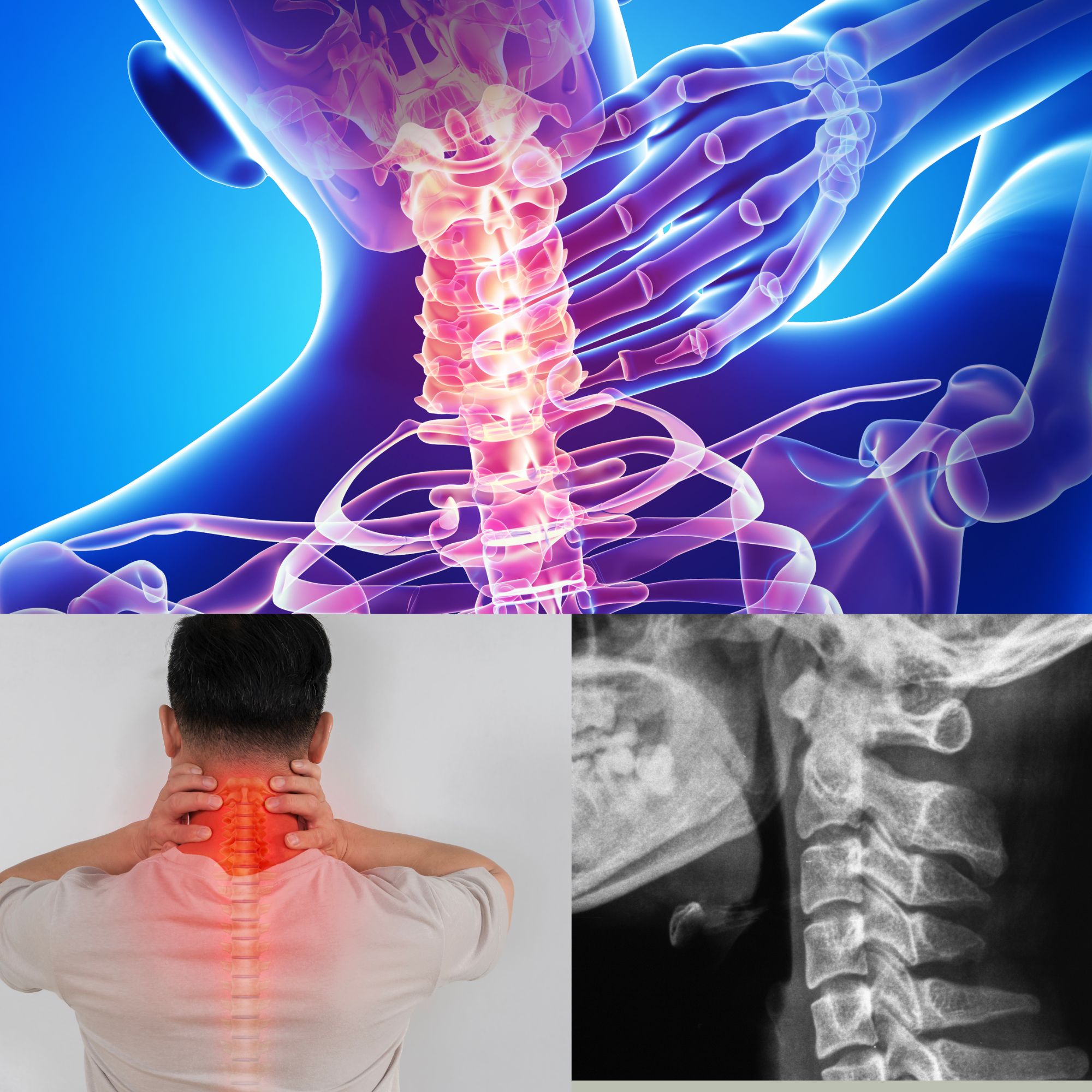
- X-rays and scans are usually not needed for a first episode of neck pain without warning signs. Wear-and-tear changes, like those on the X-ray in the picture above, are very common after 40 even in people with no pain at all, so images often show “abnormalities” that are not the cause of the problem.
- X-ray can be useful after an injury, or to look at the alignment and joints of the neck.
- MRI is reserved for nerve symptoms that do not improve, signs of weakness, suspected cord compression, or warning signs of a more serious cause.
- Blood tests may help if an inflammatory condition or infection is suspected, or to check for diabetes and other causes of nerve symptoms.
What Happens If It Is Left Untreated?
Most simple neck pain gets better by itself. But if the cause is never addressed, such as poor posture, an unsuitable pillow or long hours of strain, the pain tends to come back. Repeated episodes can lead to chronic neck pain, frequent headaches and a stiff neck. A pinched nerve that is ignored can, in some people, leave lasting numbness or weakness. Pain that never settles, or keeps getting worse, deserves a proper assessment.
How Is It Treated?
- Stay active. Rest for a day or two at most. Gentle movement and normal daily activities help you recover faster than staying still. Wearing a neck collar for long periods is not recommended, because it weakens the muscles.
- Heat. A warm compress or a warm shower for 15 to 20 minutes relaxes tight muscles. A cold pack can help in the first day or two after an injury.
- Pain relief. Paracetamol, or a short course of anti-inflammatory tablets or gel if they are safe for you. A short course of a muscle relaxant is sometimes prescribed.
- Physiotherapy. Stretching, strengthening of the neck and shoulder blade muscles, and posture correction are the foundation of treatment, especially for pain that keeps returning or lasts for weeks.
- Treatment for nerve pain. If a nerve is pinched, other medicines may be added to calm nerve pain. Most people improve without surgery.
- Injections or surgery. Only rarely, for severe nerve or spinal cord compression, or for pain that has not responded to well-delivered treatment.
- Treating the cause, for example improving your workstation and sleep, managing stress, or controlling diabetes or an inflammatory condition.
How Long Does Recovery Take?
Simple muscle-related neck pain usually improves within a few days to two or three weeks. Pain with a pinched nerve can take several weeks to a few months to settle, although most people recover well. If there is no improvement after a few weeks, or the symptoms are getting worse, see a doctor rather than waiting.
Habits That Help
- Raise your screen to eye level, and bring your phone up to your face instead of bending your head down to it.
- Take a break every 30 to 45 minutes: stand up, roll your shoulders and gently turn your head from side to side.
- Choose one supportive pillow that keeps your neck in line with your spine. Sleeping on your back or side is easier on the neck than on your stomach.
- Do not hold the phone between your ear and your shoulder.
- Carry loads evenly and close to your body, rather than on one shoulder or on your head.
- Adjust your car seat and headrest so your head is supported when you drive.
- Stay active and manage stress: walking, swimming and relaxation exercises all help to release neck tension.
When to Seek Medical Help Quickly
- 🔴 Neck pain after a fall, road accident or other significant injury: go to hospital and do not move your neck unnecessarily.
- 🔴 Fever with a very stiff neck, severe headache, vomiting, confusion or sensitivity to light: meningitis must be ruled out urgently.
- 🔴 Neck, jaw or arm pain together with chest pain, breathlessness or sweating: call SAMU (114) or go to hospital immediately.
- 🔴 A sudden, severe headache unlike any you have had before.
- 🔴 Sudden weakness or numbness in an arm or leg, difficulty walking, loss of balance, or loss of control of your bladder or bowels.
- 🟡 Neck pain that has not improved after 2 to 3 weeks, or that keeps coming back.
- 🟡 Tingling, numbness or weakness in the arm or hand, or clumsy hands.
- 🟡 Pain that wakes you at night and does not ease with a change of position.
- 🟡 Unexplained weight loss, a long-lasting low-grade fever, or a past history of cancer.
- 🟡 You have kidney disease, stomach ulcers, heart disease, high blood pressure or take blood thinners, as many painkillers may not be safe for you.
The Bottom Line
Cervicalgia is very common and, most of the time, it is not serious. Keep moving, improve your posture and sleeping habits, and use simple pain relief when you need it. Do not ignore pain that spreads down the arm, comes with numbness or weakness, or follows an injury. Those are reasons for a proper examination. And if the pain returns again and again, finding out why, rather than just treating each attack, is the best way to stop it.
If your neck pain is lasting, affecting your sleep or limiting your work, do not wait for it to go away on its own. Always consult your doctor before starting or stopping any medicine.
Neck pain that will not settle, or tingling in your hands? Message directly and ask.
Message on WhatsAppThis article is general health information and does not replace a medical consultation. In a medical emergency, call SAMU (114) or go to your nearest hospital.